
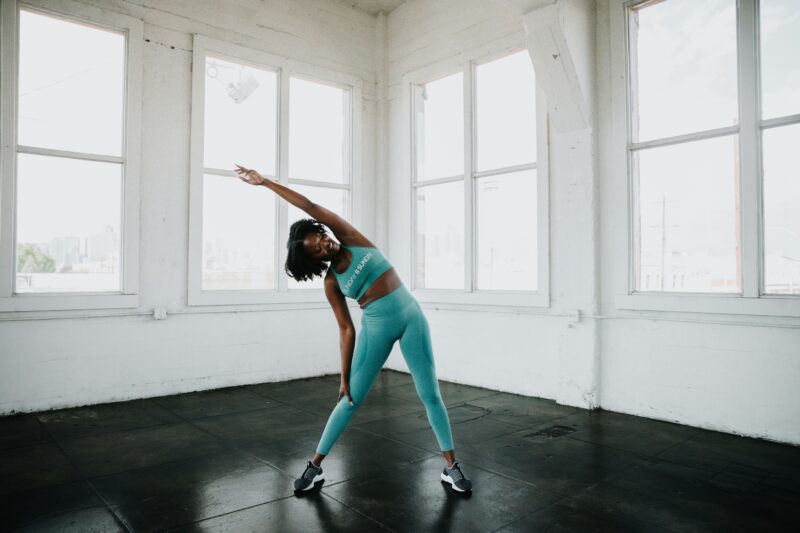
The Ultimate Standing Abs Workout: Build a Strong Core Without Getting on the Floor
For decades, the image of ab training has been synonymous with lying on a mat and performing endless crunches. However, modern exercise physiology is shifting toward a more functional approach. While floor exercises have their place, the standing abs workout is proving to be a superior method for developing a core that is not only aesthetic but also structurally sound.
If you struggle with neck strain during sit-ups or simply find floor workouts monotonous, standing core training is your ultimate solution.

The Biomechanics: Why Standing is Better for Your Core
Your abdominal muscles, the Rectus Abdominis, Obliques, and the deep Transverse Abdominis, were designed to stabilize your spine while you are upright. In daily life, you don’t use your abs while lying down; you use them to balance, lift, and rotate while standing.
According to research published in the Journal of Strength and Conditioning Research, integrated movements (those involving multiple joints and muscle groups) provide higher activation of the core stabilizers compared to isolated floor movements. When you stand, your legs and glutes must also engage to stabilize your pelvis, leading to a higher caloric burn and better functional “bracing.”
“Core stability is the ability to control the position and motion of the trunk over the pelvis to allow optimum proliferation, transfer, and control of force and motion.” — Dr. Vleeming, Clinical Anatomist.
5 Essential Standing Ab Exercises (No Equipment)
Perform this routine as a circuit. Complete each move for 45 seconds, rest for 15 seconds, and repeat the entire circuit 3–4 times.
01. Standing March with Twist
Target: Rectus Abdominis and Obliques. This move mimics the Bicycle Crunch but adds a balance component that forces the deep core to stabilize.
- How to do it: Stand with feet hip-width apart, hands behind your head. Lift your right knee toward your chest while rotating your left elbow to meet it. Alternate sides.
- The Science Tip: Focus on the “crunch” in the middle. Don’t just move your limbs; imagine pulling your belly button toward your spine as you rotate.
02. Windmills
Target: Internal and External Obliques. Windmills focus on lateral flexibility and eccentric control—where the muscle lengthens under tension.
- How to do it: Stand with a wide stance. Point your left foot out. Reach your right arm toward the ceiling and slide your left hand down your left leg, hinging at the hips. Keep your eyes on your top hand.
- The Science Tip: This exercise engages the Quadratus Lumborum, a deep back muscle that supports the core, helping to prevent the lower back pain often associated with weak abs.
03. Standing Side Crunches
Target: Obliques and Lateral Core. This is the ultimate move for toning the sides of the waist and improving pelvic stability.
- How to do it: Shift your weight to your left leg. Reach your right arm up and extend your right leg out. Simultaneously bring your right elbow and right knee together at your side.
- The Science Tip: Research shows that unilateral (one-sided) standing movements significantly increase the demand on the Gluteus Medius, which works in tandem with the obliques to keep the torso upright.
04. Overhead Reach with Knee Drive
Target: Lower Abs and Heart Rate. This is a compound movement that acts as both a core strengthener and a cardio booster.
- How to do it: Reach both arms overhead. Step back into a slight lunge with your right leg. Explosively drive your right knee toward your chest while pulling your hands down to meet it.
05. Standing Woodchops
Target: Transverse Abdominis and Rotational Power. This exercise replicates functional movements like swinging a bat or lifting a heavy box.
- How to do it: Interlock your fingers. Start with your hands near your right hip (knees slightly bent). In one fluid motion, “chop” your arms diagonally across your body and above your left shoulder, pivoting your right foot.
Practical Benefits: Beyond the Six-Pack
A. Reduced Neck and Back Strain
Many beginners perform floor crunches by pulling on their necks, leading to cervical strain. Standing abs remove this risk entirely, keeping the spine in a neutral, safe position.
B. Improved Posture
Standing core work emphasizes the Posterior Chain. By strengthening the abs in an upright position, you naturally counteract the hunched posture caused by prolonged sitting at desks.
C. Real-World Power
Whether you’re carrying groceries or playing a sport, your core strength is tested while you are on your feet. Standing workouts train your muscles to be “ready” for these real-life loads.
| Day | Focus | Duration |
| Monday | High Intensity (Knee Drives & Marching) | 15 Mins |
| Tuesday | Recovery / Active Walk | 20 Mins |
| Wednesday | Stability & Rotation (Windmills & Woodchops) | 15 Mins |
| Thursday | Rest | – |
| Friday | Full Circuit (All 5 moves) | 20 Mins |
| Saturday | Outdoor Activity (Hiking/Swimming) | 30 Mins |
| Sunday | Rest | – |